Most people choose a shampoo based on the front of the bottle. They buy the one that promises thicker hair, or the one their friend recommended, or the one with the most appealing packaging. Then they wonder why their hair keeps thinning, their scalp keeps itching, or the medicated serums they spend money on stop producing results after a few months.
The shampoo step is the one that makes or breaks everything else in a hair care routine. Not because shampoo regrows hair or stops androgenetic alopecia, it cannot do either of those things, but because a shampoo that strips the scalp’s natural acid mantle, leaves behind surfactant residue, or fails to remove mineral buildup from Pakistan’s hard water creates a compromised surface that reduces the effectiveness of every treatment applied afterward. A poorly chosen shampoo is the hidden variable behind many failed hair care routines.
Choosing the right one starts with three questions, not one: What is your scalp type? What problem are you trying to solve? And what does your water actually do to your hair?
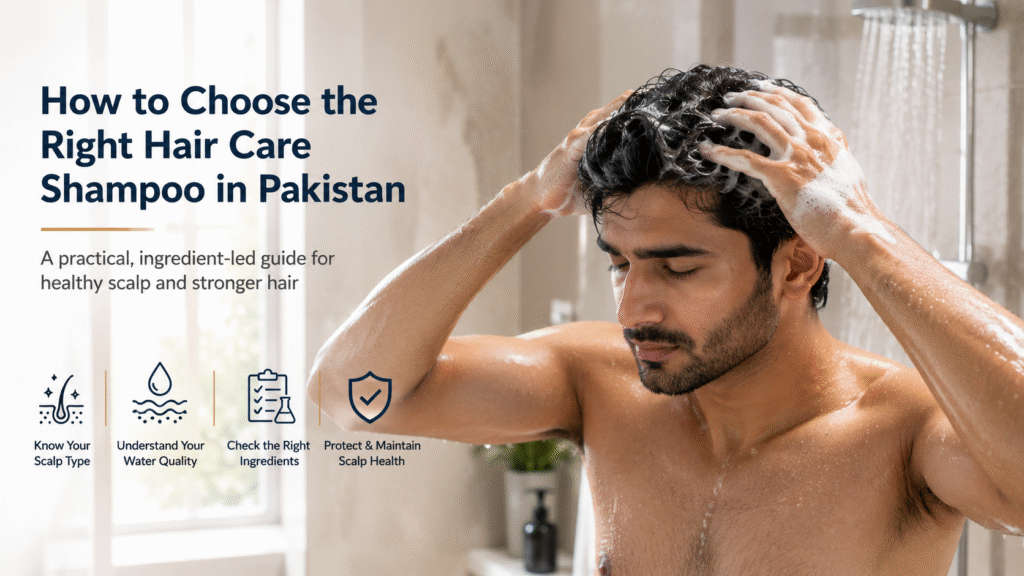
Pakistan’s Water Is Not a Minor Detail
Hard water is the most under-discussed factor in Pakistani hair care. Municipal water in Lahore, Karachi, Islamabad, Faisalabad, and most major urban centres contains elevated concentrations of dissolved calcium and magnesium. Every time you wash your hair, these minerals deposit on the scalp and hair shaft. Over weeks and months they accumulate into a mineral film that does three things: it disrupts the scalp’s acid mantle, it reduces how much of any topical treatment can absorb into the follicle, and it structurally weakens the hair cuticle by competing with its moisture bonds.
A shampoo that does not account for this creates a cycle where the scalp is never properly clean in the way it needs to be. Mineral scale continues building, the scalp’s natural environment tilts toward dryness and irritation, and any serum, oil, or topical treatment applied to it works at a fraction of its clinical potential.
This is one reason that choosing from the hair care products in Pakistan that are actually formulated for local water conditions is not just marketing language, it is a meaningful technical distinction. A clarifying or mineral-cleansing shampoo designed for Pakistani tap water removes deposits left by standard surfactant formulations. The scalp that results from using it correctly is a fundamentally different absorption environment.
The same water quality issue affects the skin on your face and body. If you have been struggling with persistent dullness, uneven texture, or products that seem to stop working after a few weeks of use, mineral water buildup on the skin is often a factor. The best skin care products in Pakistan are designed for local conditions, accounting for this in their formulation’s pH and surfactant selection, which is why locally developed, pharmacist-formulated options consistently outperform imported alternatives that assume European or North American water quality.
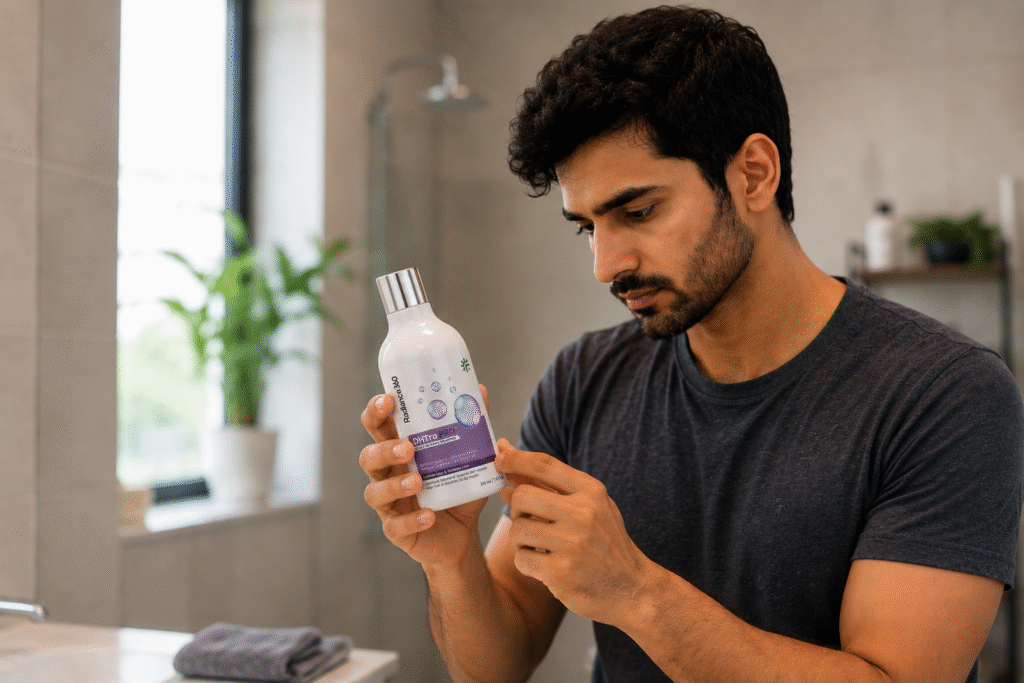
The Four Scalp Types and What Each One Needs from a Shampoo
Choosing a shampoo without knowing your scalp type is like choosing a moisturiser without knowing your skin type. The outcome is random at best and counterproductive at worst.
Oily scalp. Excess sebum is the most common scalp type in Pakistan, driven by heat, humidity, and in some cases hormonal activity. An oily scalp is not a cleanliness problem. It is a sebaceous gland output problem that worsens in temperatures above 30°C and in humidity above 60%, both of which describe most of Pakistan’s urban environment for the majority of the year. The right shampoo for an oily scalp removes excess sebum without triggering the rebound overproduction that follows over-stripping. Surfactants like cocamidopropyl betaine and sodium lauroyl sarcosinate cleanse effectively without the harshness of sodium lauryl sulphate (SLS), which removes so much lipid that sebaceous glands compensate by producing more oil within hours of washing. Clarifying shampoos containing salicylic acid at 1% to 2% help dissolve sebum plugs inside follicle openings, which reduces the congestion that makes oily scalps prone to dandruff.
Dry and sensitive scalp. A dry scalp in Pakistan’s climate is usually a barrier-compromised scalp, often worsened by hard water alkalinity stripping the acid mantle repeatedly over time. The wrong shampoo here is any formulation heavy in sulphates, alcohol, or fragrance, all of which further disrupt an already compromised barrier. Sulphate-free formulations built on gentle amphoteric surfactants allow cleansing without stripping. Ingredients like D-Panthenol (provitamin B5) and glycerin in the shampoo base help restore barrier hydration during the wash step itself.
Scalp with dandruff or seborrhoeic dermatitis. This is the category most Pakistani men and women fall into at some point, particularly during summer humidity or winter dryness. Dandruff is primarily a fungal condition caused by Malassezia overgrowth, not a dry scalp problem or a hygiene problem. Standard shampoos do not treat it because they do not contain antifungal actives. A medicated shampoo containing Zinc Pyrithione, Piroctone Olamine, Climbazole, or Ketoconazole is required. The critical distinction between these actives is contact time and daily use tolerability. Ketoconazole 2% is the most potent antifungal active for severe cases but is associated with scalp dryness and is designed for short-term intervention, not daily maintenance. Zinc Pyrithione and Piroctone Olamine combined offer comparable efficacy for mild to moderate dandruff with better long-term tolerability. A leave-on formula, rather than a rinse-off shampoo, maintains active contact time with the scalp and produces more consistent results because it is not washed away immediately after application.
Scalp undergoing active hair loss treatment. If you are using a Minoxidil-based topical serum for hair loss, the shampoo you use matters more than in any other context. The serum needs a clean, mineral-free, properly pH-balanced scalp surface to absorb at clinical concentration. A Hair Treatment Shampoo designed for pre-treatment preparation, one that removes hard water deposits, excess sebum, and product residue without disrupting the acid mantle, can meaningfully improve how much of the active ingredient reaches the follicle. Using the wrong shampoo, particularly a sulphate-heavy clarifying shampoo that strips too aggressively, dries the scalp and triggers inflammation that then reduces follicle receptivity. The shampoo step in a pharmaceutical hair loss routine is preparation, not just cleansing.
What Shampoo Ingredients Actually Do and Which Ones Do Not Do What the Label Claims
Shampoo marketing in Pakistan is aggressive and frequently disconnected from the actual chemistry of the products being sold. Here is an honest breakdown of the common claims.
Biotin in shampoo does not treat hair loss
Biotin is a water-soluble B vitamin. In shampoo, it is rinsed off within minutes of application and does not penetrate the follicle in any therapeutically meaningful amount. Topical biotin has no credible clinical evidence for improving hair density in people without a biotin deficiency. The presence of biotin in a shampoo tells you nothing useful about its efficacy for hair loss.
Caffeine in leave-on products has published evidence; in rinse-off shampoos it is marginal
A study published in the International Journal of Dermatology found that caffeine at 0.001% could counteract testosterone-induced suppression of hair follicle growth in isolated human follicles. However, this evidence was generated with extended contact time. A shampoo that is rinsed off after two minutes provides minimal exposure. If caffeine is a reason you are choosing a shampoo, verify whether the formulation is rinse-off or leave-on.
Ketoconazole 2% in shampoo has genuine clinical evidence for both dandruff and, in some studies, a mild DHT-related effect on follicles
Research published in the Journal of the American Academy of Dermatology showed that ketoconazole shampoo used intermittently alongside minoxidil improved outcomes compared to minoxidil alone in men with androgenetic alopecia. The mechanism is not fully established but may relate to anti-inflammatory effects on the scalp. It is worth noting that this evidence applies to ketoconazole 2%, not the 1% concentration found in most over-the-counter formulations.
Sulphate-free does not automatically mean better
Sulphate-free shampoos are gentler on the cuticle and less likely to strip the acid mantle. They are the right choice for dry, sensitive, or colour-treated hair. But for someone with an oily scalp, a heavy sebum burden, or significant mineral scale buildup, a sulphate-free shampoo may not cleanse thoroughly enough. The objective is to match surfactant strength to cleansing need, not to use the mildest option regardless of what the scalp actually requires.
Wash Frequency: Another Question With a Pakistan-Specific Answer
Standard Western hair care advice suggests washing two to three times per week to preserve natural oils. In Pakistan’s climate, particularly during summer months when ambient temperatures exceed 35°C and humidity stays high, this schedule produces scalp conditions that most of the people giving that advice have never experienced. Sweat accumulation, accelerated sebum production, and dust and pollution deposition in a single day of Lahore traffic can create a scalp environment that genuinely requires daily or near-daily cleansing.
The answer to how often to wash is not a universal number. It is the frequency at which your scalp stays comfortable, clean, and free of buildup without tipping into dryness. For most Pakistanis with oily scalps in summer, daily washing with a gentle, sulphate-free formulation that does not over-strip is appropriate. In winter, when scalp oil production decreases and dryness is more likely, reducing to every other day and switching to a hydrating formulation makes more sense.
The Shampoo-Serum Relationship Most People Miss
A hair loss serum applied to a scalp coated with residual shampoo surfactant, mineral scale, or sebum buildup does not absorb at the concentration you believe it is delivering. This is the mechanical reason why some people spend months using well-formulated topical treatments and see less than expected results: the delivery vehicle is compromised at the point of application.
Using a dedicated Hair Treatment Shampoo before applying a pharmaceutical topical serum removes the absorption barriers that standard shampoos leave behind. The difference in outcomes between a properly cleansed scalp and one washed with a random commercial shampoo is not trivial. It is the difference between a clinical dose of Minoxidil reaching the follicle and a fraction of that dose reaching it, with the rest sitting in residue on the scalp surface.
This relationship between shampoo choice and serum performance applies to skincare as well. Active serums for pigmentation, acne, or anti-ageing perform differently on a properly cleansed and pH-balanced skin surface versus one still coated in hard water mineral residue and surfactant film. Getting the cleansing step right is upstream of everything else in the routine.
A Framework for Choosing
Rather than recommending specific products by brand name, the most useful thing this article can offer is a decision framework.
Identify your scalp type first, not your hair type. Scalp is where the problem lives. Hair type determines texture and styling needs but scalp type determines what your shampoo formula needs to achieve.
Read the active ingredient list, not the front of the bottle. If a shampoo claims to treat dandruff, the active ingredient treating dandruff should be listed with its concentration. If it claims to reduce hair fall through a specific mechanism, that ingredient should be present at a dose with published evidence. Vague claims of “clinically proven” or “dermatologist tested” without disclosed concentrations are marketing language, not clinical data.
Match the shampoo to the water. If you are in a city with hard municipal water and you have not been using a chelating or mineral-clearing formulation, switching to one is the single highest-impact change you can make to your cleansing routine.
Treat your shampoo as preparation, not treatment. No shampoo will stop androgenetic alopecia or regrow lost hair. The role of shampoo in a hair loss routine is to create the cleanest, most receptive scalp environment possible for the actives that do have that evidence.